Total Pageviews

Wednesday, July 08, 2020

shel silverstein, the bloat (sic) bloath


Workers Comp Insurance Scofflaw, Precautions to Workers

My home 210 West 4th Street, the Dalles.

*****


work for a horrible boss, lead paint removal and exposure. a very difficult homeowner, too, who i know from 30 years ago in Kansas


looking good after so much toxic prep iinvolving heat guns to remove lead paint down to smooth pure wood.


Forest Bloggod, out of PPE hazmat suit. the paint scraped off by hand and heat guns weighed over 100 pounds, which boss owner disposed of in a professional manner, as we dutifully tarped and vaccumed.

 dangerous as hell, recklessly negligent and stressed boss owner, never on site

NW Painting Specialists, Portland Oregon
Boss owner lied to his workers including myself, who learned he didn't have Legally Required Worker's Comp Insurance.

 No insurance on Commercial job apartments, lead paint dust everywhere, no PPE provided by Boss Smith who was vacationing in Maine. smoke from wildfires also filled the air those apocalyptic seeming dsys. Caleb, Joey, Trace, Forest....so much work for CRAP pay and risking our lives while boss hadn't carried Worker's Comp for SEVERAL business years.


50, 000 bees or something like that, wrapped the hives with no problems or hurt Workers


Arc Stone projects, biggest Juniper beam retaining wall in the USA, Portland Oregon


ipe, cedar. carpentry by Bierger


******

Juniper 6 by 6 retaining walls, each four feet tall and 80 feet long
beams pinioned with rebar
set on gravel, backfilled with dozens of yards of gravel for drainage


Arc Stone projects 2015, 2016


stone work, wood, landscaping

 bluestone patio, doublesided cedar fence, ipe hardwood deck, raingarden. NE Portlsnd, 2015


oxidixed steel, cedar


Thursday, July 02, 2020

dalles


water gravity powers this word
columbia
indentured slave

keeps google
rich

stuffed animal heaven


glorious pyre
revelry practice
turnip tit sun nip

voluminous
density sic destiny

outboard everything.
everything natural

peace wins
stuffed animal heaven

inhibition hibernation
figure fig


Lee Resolution, July 2, 1776


"The Lee Resolution (also known as "The Resolution for Independence") was the formal assertion passed by the Second Continental Congress on July 2, 1776 which resolved that the Thirteen Colonies in America were "free and independent States", separated from the British Empire and creating what became the United States of America.

 News of this act was published that evening in the Pennsylvania Evening Post and the next day in the Pennsylvania Gazette.

The Declaration of Independence is the formal document which officially announced and explained the resolution, approved two days later on July 4, 1776.

The resolution is named for Richard Henry Lee of Virginia who proposed it to Congress after receiving instructions from the Virginia Convention and its President Edmund Pendleton. Lee's full resolution had three parts which were considered by Congress on June 7, 1776."

https://en.wikipedia.org/wiki/Lee_Resolution


"In the U.S., the family began when Richard Lee I emigrated to Virginia and made his fortune in tobacco. His son Richard Lee II married Leticia Corbin, daughter of The Hon. Henry Corbin (colonist) of Rappahannock County, was a member of the House of Burgesses and later King's Council.

His son, Richard Lee III, was a cotton broker in London for the family and leased to his brothers Thomas and Henry the plantation he inherited from his father, "Machodoc," for "an annual rent of one peppercorn only, payable on Christmas Day".

https://en.wikipedia.org/wiki/Lee_family

Wednesday, July 01, 2020

Tulip tree (fiddle tree) 1890s portland


"Originally described by Carl Linnaeus, Liriodendron tulipifera is one of two species (see also L. chinense) in the genus Liriodendron in the magnolia family. The name Liriodendron is Greek for "lily tree".

It is also called the tuliptree Magnolia, or sometimes, by the lumber industry, as the tulip-poplar or yellow-poplar. However, it is not closely related to true lilies, tulips or poplars.

The tulip tree has impressed itself upon popular attention in many ways, and consequently has many common names. The tree's traditional name in the Miami-Illinois language is "oonseentia". 

Native Americans so habitually made their dugout canoes of its trunk that the early settlers west of the Appalachian Mountains called it Canoewood. The color of its wood gives it the name Whitewood. In areas near the Mississippi River it is called a poplar largely because of the fluttering habits of its leaves, in which it resembles trees of that genus. 

It is sometimes called "fiddle tree," because its peculiar leaves, with their arched bases and in-cut sides, suggest the violin shape."

__________


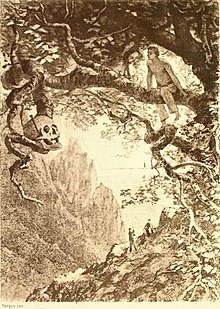
"The Gold-Bug" is a short story by Edgar Allan Poe published in 1843. The plot follows William Legrand, who was bitten by a gold-colored bug. His servant Jupiter fears that Legrand is going insane and goes to Legrand's friend, an unnamed narrator, who agrees to visit his old friend. Legrand pulls the other two into an adventure after deciphering a secret message that will lead to a buried treasure.

The story, set on Sullivan's Island, South Carolina, is often compared with Poe's "tales of ratiocination" as an early form of detective fiction. Poe became aware of the public's interest in secret writing in 1840 and asked readers to challenge his skills as a code-breaker. He took advantage of the popularity of cryptography as he was writing "The Gold-Bug", and the success of the story centers on one such cryptogram. Modern critics have judged the characterization of Legrand's servant Jupiter as racist, especially because of his comical dialect speech.

Poe submitted "The Gold-Bug" as an entry to a writing contest sponsored by the Philadelphia Dollar Newspaper. His story won the grand prize and was published in three installments, beginning in June 1843. The prize also included $100, probably the largest single sum that Poe received for any of his works. "The Gold-Bug" was an instant success and was the most popular and most widely read of Poe's works during his lifetime. It also helped popularize cryptograms and secret writing."


Elaborate drawing of a man sitting on a tree limb, looking at a skull on one of its branches. Two small figures can be seen on the slopes beneath him.